
A flawless, glass-like epoxy finish isn’t just “pour, torch, pray.” On large table tops and countertops, the resin is doing a balancing act between surface energy (how well it wets the surface), viscosity (how it flows and levels), and time (how long it stays workable before it thickens).
When something in that triangle is off, you get the whole family of “epoxy didn’t behave” defects:
- Fish eyes (perfect little craters where the resin pulls away)
- Craters / dimples / dry islands (the film breaks or thins until the substrate shows through)
- Uneven sheen (glossy in some zones, dull in others)
- Texture that won’t self-level (ripples, ridges, orange peel)

This guide explains what’s actually happening — and how to prevent and fix it — using the right resin for the job, with a clear product split so you can choose correctly (especially if you’re coating a large surface).
The Fastest Path to a Glass Finish
- Fish eyes and dry spots happen when epoxy can’t wet the surface evenly (contamination, surface energy mismatch, or a film that’s too thin).
- Big surfaces magnify problems because resin runs off edges, thins out, and gives contaminants more chances to break the film.
- Viscosity matters: a table top coat needs a resin formulated to self-level into a stable, continuous film.
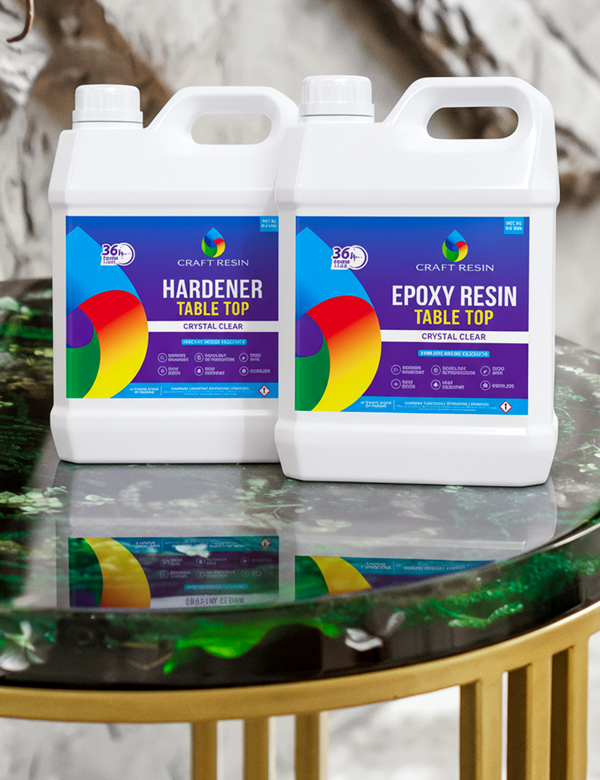
- Craft Resin Table Top Epoxy is built for coating large surfaces with high gloss, using a 1:1 mix ratio and an optimized mixed viscosity of 3800 CPS for self-leveling and bubble release.
- If defects appear mid-pour: don’t panic-scrub the surface. Often the cleanest fix is let it cure, sand flat, clean properly, and recoat.
- For true “glass,” you can either nail the pour or sand and polish after full cure.
What Fish Eyes Really Are (and What They Aren’t)
Fish eyes (classic)
Fish eyes are those clean, round craters that look like the resin “ran away” from small points on the surface. That’s usually because something on (or in) the surface has lower surface energy than the resin — the film breaks, retracts, and exposes the substrate.
Common culprits:
- Silicone (furniture polish, some sprays, car detailing products)
- Wax (waxed wood, some finishing products, some tack cloth residues)
- Oils (skin oils, machining oils, oily woods not prepped correctly)
- Cleaning residues (certain household cleaners leave surfactants behind)
The “not-quite fish eye” defects you also need to solve
You asked to include “all moments when resin spreads incorrectly” — so here’s the broader set you’ll see on table tops:
- Dry spots / bare islands: the resin film gets too thin to stay continuous (often near edges or high spots).
- Craters / dimples: can be contamination or trapped air/outgassing that collapses a bubble and leaves a crater.
- Pinholes: tiny holes often caused by air escaping from wood pores as the resin warms.
- Uneven sheen: some areas cure with a different surface texture or thickness (thin zones can look dull even if cured).
- Bottom line: fish eyes are a wetting failure. On a large surface, you’ll often see multiple wetting-related defects at once.
Why Large Table Tops and Countertops Magnify Fish Eyes
A coaster-sized pour is forgiving. A 6-foot table top is not.
1) Film thickness becomes uneven
Gravity pulls resin outward, and edges act like drains. Thin zones are where wetting fails first — because the film can’t “bridge” over micro-contamination or surface texture.
2) More square footage = more chances to hit contamination
One silicone aerosol used somewhere in the room two days ago can still settle out. One oily fingerprint. One contaminated rag. On a big top, it only takes a few “hot spots” to ruin the illusion of glass.
3) Big pours invite overworking
Chasing a crater with a spreader for five minutes usually makes it worse — you’re thinning the film and dragging contaminants around.
Viscosity, Self-Leveling, and Why “One Epoxy for Everything” Causes Defects
If you remember one technical concept from this article, make it this:
On a table top, you’re not “casting.” You’re building a continuous surface film.
That film needs a resin viscosity designed for coating — not deep pouring.
What viscosity changes in real life
Viscosity controls:
- how fast the resin flows and levels
- whether it runs off edges (creating thin zones)
- how easily bubbles rise and release
- how stable the film is over contaminants and surface texture
The viscosity window for table tops
- Too thin: runs off edges, leaves dry zones, exposes contamination issues quickly.
- Too thick: doesn’t level smoothly, traps texture, and can leave ridges.
Why a table top epoxy is formulated differently than deep pour epoxy
Deep pour formulas are designed to pour thick (river tables) with lower heat build-up and long working time. That’s great for mass pours — but it’s not automatically great for a thin, glossy “glass sheet” on top.
A dedicated coating resin gives you:
- a stable, self-leveling film
- predictable flow and edge behavior
- strong surface hardness and scratch resistance once cured
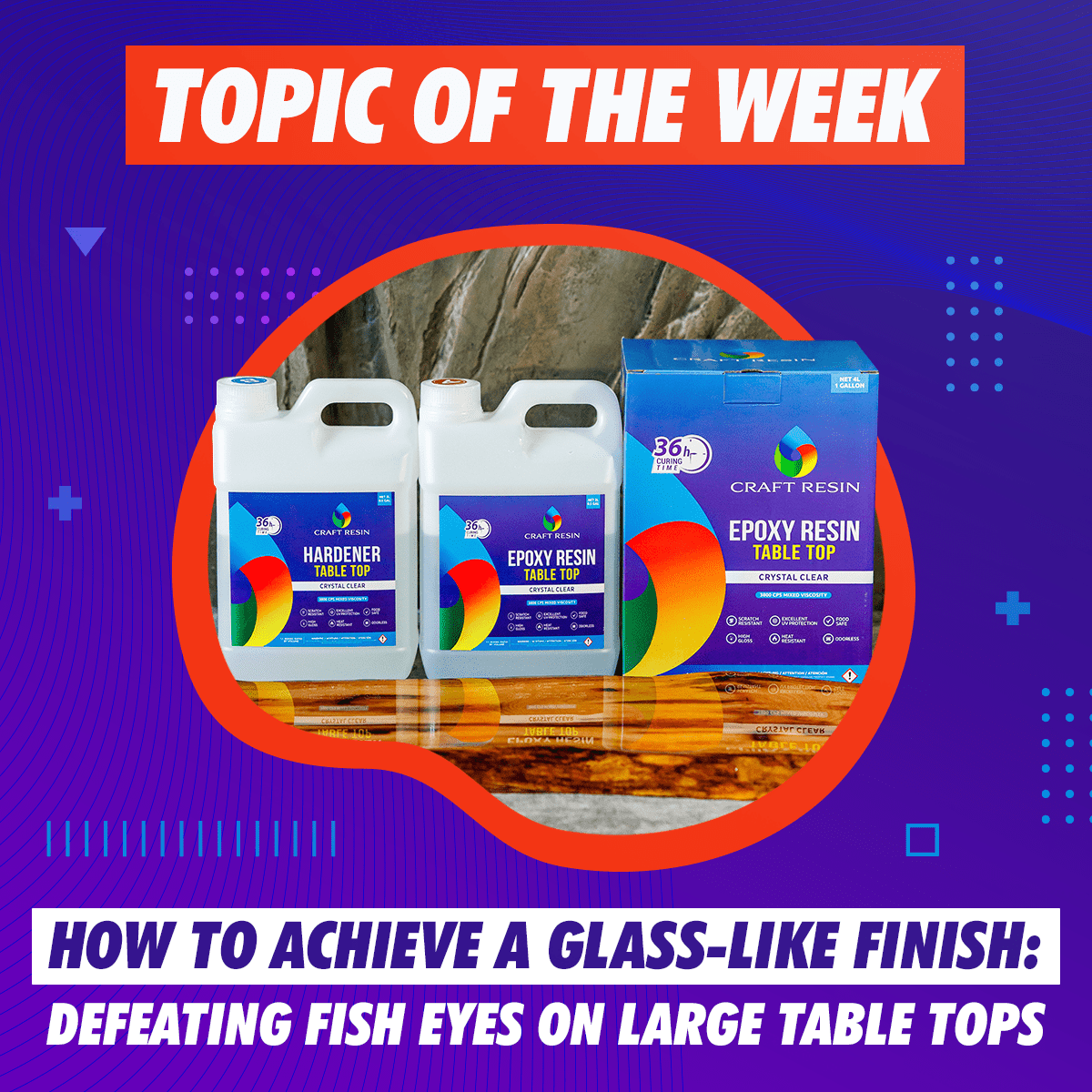
Craft Resin Table Top Epoxy is engineered for this exact use case, with a 1:1 mixing ratio by volume and a mixed viscosity of 3800 CPS to support self-leveling, smooth application, and natural bubble release.
Product Picker — Choose the Right Craft Resin for the Job
If you’re trying to get a glass finish on a table top or countertop, picking the right resin removes most of the drama.
If you’re coating a table top, counter top, or bar surface

Choose: Craft Resin Table Top Epoxy (1 Gallon / 4L option available)
Why it fits the job:
- 1:1 by volume mixing ratio (simple and consistent)
- Optimized viscosity for coating: Mixed 3800 CPS (at 77°F / 25°C)
- Working time / pot life: ~40 minutes at 72–77°F / 23–25°C
- Cure: hard cure ~36 hours, full cure ~48 hours
- Heat resistance: suitable up to 176°F / 80°C after a full 21-day cure
- Coverage: 1 L covers 1.15 m² (useful for planning coats)
- No VOCs / no fumes, BPA-free; conforms to ASTM D-4236 (a labelling standard for art materials, not a safety approval)
This is the resin you want when the goal is high-gloss durability on wide, visible surfaces.
If you’re doing a river table or thick casting
Choose: Craft Resin Casting — Deep Pour
Use it for deep layers (e.g., river pours). It’s designed for thick-volume control and lower heat — not for a thin “glass coat.”
If you’re doing art panels or smaller casting with crisp detail
Choose: Craft Resin Casting — Art & Craft
Great for controlled pours and detailed pieces — but again, not the first choice for a large, glossy table top coat.
Prevention Workflow — Prep That Actually Prevents Fish Eyes
Here’s the honest truth: you can’t “technique” your way out of contamination. Prevention is mostly about controlling what touches the surface.
Case A — New wood table tops (fresh build)
New tops are easier because you control the materials from the start.
1) Sand to a uniform scratch pattern
- Your goal is consistency — not perfection.
- Uneven sanding can create areas that wet differently.
2) Remove dust like you mean it
- Vacuum first.
- Then use a clean microfiber or lint-free cloth.
- Be careful with tack cloths — some can leave residues that affect wetting.
3) Watch oily woods
Some species (or boards with oily patches) can fight wetting. If you suspect this, you’re better off:
- sanding well
- wiping correctly (see the solvent wipe method below)
- and considering a seal strategy (next point)
4) Decide whether you need a seal coat
A seal coat helps when:
- the wood is porous and likely to outgas
- you want to lock down pores before the flood coat
A seal coat can hurt when:
- you apply it too thin and create a patchy “half-sealed” surface
- you contaminate it during cure
If you seal, keep it clean and recoat on schedule.
Case B — Refinishing an existing top (higher risk)
Refinishing is where fish eyes become “legendary,” because old tops have history — and history often includes silicone.
High-risk signs:
- The surface was ever treated with “shine,” “polish,” or “protect,” or automotive-style products.
- It feels slick even after sanding.
- Water beads aggressively in certain spots.
The decontamination ladder (do this in order)
1) Mechanically remove the old finish
If it’s a finished piece, sanding just enough to scuff is often not enough. You want to sand past the contaminated layer.
2) Solvent wipe (the correct way)
This is where most people fail — not because the solvent is wrong, but because the wiping method re-deposits contamination.
Use a two-cloth method:
- Cloth A: apply solvent and lift contaminants
- Cloth B: immediately wipe dry before it flashes and redeposits
Use fresh cloth sections constantly. One dirty rag can spread silicone across the entire surface.
3) Isolate if needed
If you can’t confidently remove contamination (or you’re dealing with mystery surfaces), a barrier strategy can help — but it must be compatible and applied cleanly.
Shop environment controls (small effort, huge payoff)
Craft Resin Table Top Epoxy cures best when your room is stable, in the 77–85°F / 25–30°C range, and not fluctuating.
Also:
- Keep aerosols out of the shop area.
- Don’t apply epoxy near fresh paint, sprays, or silicone-based products.
- Reduce dust while resin is open.
During the Pour — Keep the Film Continuous and Let the Resin Self-Level
This section is deliberately not a “full table build tutorial.” It’s about what matters for wetting and flow.
1) Aim for a stable film thickness
Most dry spots happen because the coat is too thin in places (usually near edges or high points). Your job is to spread the resin to a continuous film and then stop messing with it.
2) Manage edges so they don’t drain your coat
Edges are where the resin wants to run off, thinning the top surface. If you starve the edges, you create the perfect conditions for dry zones and uneven sheen.
3) Mix accurately and don’t rush the blend

Craft Resin Table Top Epoxy is 1:1 by volume.
The practical advice here:
- mix thoroughly (scrape sides and bottom)
- then pour into a second container and mix briefly again (a “double mix” helps avoid streaks)
4) Don’t overwork a problem spot
If you see a crater forming, the instinct is to chase it with a spreader. On a large surface, that often:
- thins the film locally
- spreads contamination outward
- creates more defects than you started with
Instead, shift into the rescue plan mindset below.
If Fish Eyes or Dry Spots Appear — Rescue Plan (Without Ruining the Finish)
This is the section that saves projects.
Step 1: Identify the stage
Ask: Is the resin still flowing easily, or is it starting to gel?
- Early stage (very fluid): you have limited options, and aggressive fixing can backfire.
- Late stage (thickening/gel): the best fix is usually mechanical — after cure.
If it’s still very wet (early stage)
Try the least invasive interventions first:
- Stop touching it for a minute. Sometimes the film re-establishes.
- Remove the contamination source. Change gloves. Remove rags from the area. Stop airflow that’s carrying aerosols/dust.
- Maintain film continuity. A gentle reflow can help, but avoid scraping and spreading.
If fish eyes keep reappearing in the same spots, you’re likely dealing with contamination that needs to be sanded out later.
If it’s thickening (late stage) — the clean professional fix
- Let it cure fully (don’t “half sand” gummy epoxy). Craft Resin Table Top Epoxy reaches hard cure around 36 hours and full cure around 48 hours.
- Sand flat until the crater edges disappear Your goal is to level the defect, not just scuff the gloss.
- Clean correctly Remove sanding dust completely.
- Recoat with a proper table top resin This is where using a coating resin with the right flow behavior matters most.
Pro note: On large glossy surfaces, spot repairs often show. A full thin recoat is usually more invisible than micro-patching.
After Cure — Sanding, Polishing, and Getting a True Glass Finish

You can get a glass finish two ways:
- a perfect pour (high-gloss “as poured”), or
- controlled refinement (sand + polish)
Cure timing matters (especially for heat and durability)
Craft Resin Table Top Epoxy is suitable for applications up to 176°F / 80°C only after a full 21-day cure (post-cure).
So if you’re planning real countertop use, treat the first few weeks as a “gentle use” period.
Sanding strategy (overview)
- Sanding is about flattening and refining.
- If you’re removing defects, you start coarse enough to level them, then step up gradually.
Polishing (for that “wet glass” look)
Polishing is the final 10% that makes a finish look professional in direct light:
- Use the right pad and compound sequence.
- Keep the surface clean to avoid swirl marks.
- Don’t rush — heat from aggressive polishing can soften a surface that isn’t fully cured.
If your finish is already level but just not “showroom glossy,” polishing is often faster than recoating.
Why Craft Resin Table Top Epoxy Makes This Easier (Without the Hype)

A table top finish fails when the resin can’t form and maintain a stable surface film. Craft Resin Table Top Epoxy is designed to support that film on wide surfaces:
- High-viscosity system with mixed 3800 CPS for controlled flow and self-leveling
- 40-minute working time at typical shop temps gives you time to spread without rushing
- Hard cure ~36 hours, full cure ~48 hours for predictable sanding/recoat timing
- No VOCs / no fumes, BPA-free, and effective anti-yellowing protection per technical info
- Most importantly: it’s purpose-built for table tops, counters, and bar surfaces — the exact applications where fish eyes and dry spots are most visible.
FAQ — Fish Eyes, Self-Leveling, and Resin Finish Problems
What causes fish eyes in table top epoxy resin?
Usually silicone, wax, oils, or residues that change surface energy so the epoxy can’t wet evenly.
Can I fix fish eyes after epoxy cures?
Yes. The clean fix is: let it cure, sand flat to remove crater edges, clean thoroughly, then recoat.
Will a second coat remove craters and dry spots?
If you sand and clean properly first, a second coat often restores a continuous film and an even gloss. If you don’t remove contamination, the defects can repeat.
Is fish eye caused by silicone only?
Silicone is common, but waxes, oils, surfactants from cleaners, and some residues can cause similar wetting failures.
What viscosity is best for a glass-like table top epoxy finish?
You want a coating resin designed to self-level into a stable film. Craft Resin Table Top Epoxy uses a mixed viscosity of 3800 CPS (77°F / 25°C) for that purpose.
Why does epoxy look glossy in spots but dull in others?
Often uneven film thickness, dry zones, or surface texture differences (from sanding, contamination, or cure conditions).
Should I use deep pour epoxy as a top coat?
You can sometimes get results, but it’s not optimized for thin high-gloss coating behavior. For table tops/counters, a dedicated table top epoxy is the safer choice.
When can I sand and polish epoxy resin?
Once it has reached a firm cure. For Craft Resin Table Top Epoxy, hard cure is around 36 hours and full cure around 48 hours (conditions matter).
How do I keep epoxy from running off edges?
Plan edge management, maintain sufficient film thickness near edges, and avoid overworking which thins the coat.
Is table top epoxy food safe?
It is suitable for incidental food contact once fully cured — food that touches the surface briefly and in passing. It is not intended for direct or prolonged food contact. Always follow product guidance and local regulations for food-contact surfaces.